
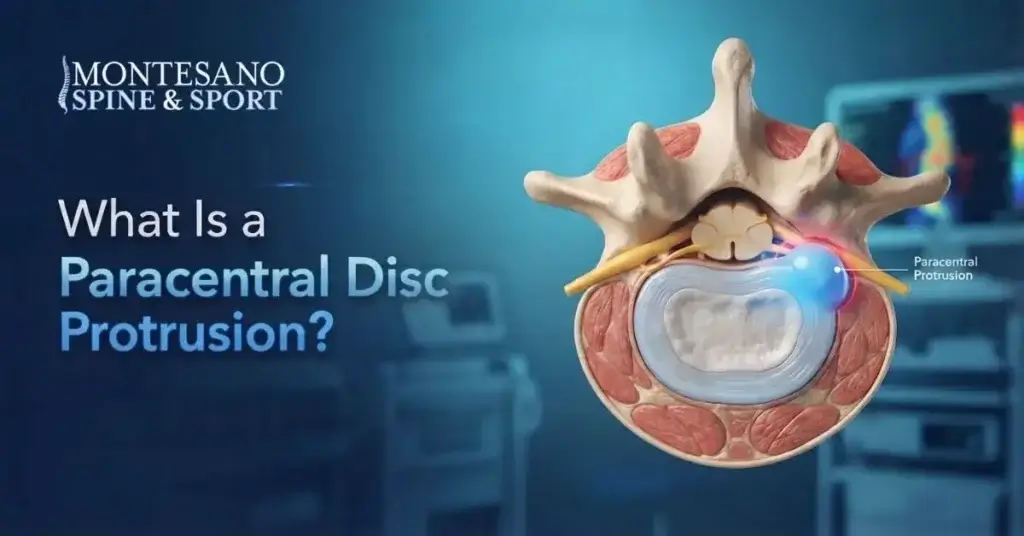
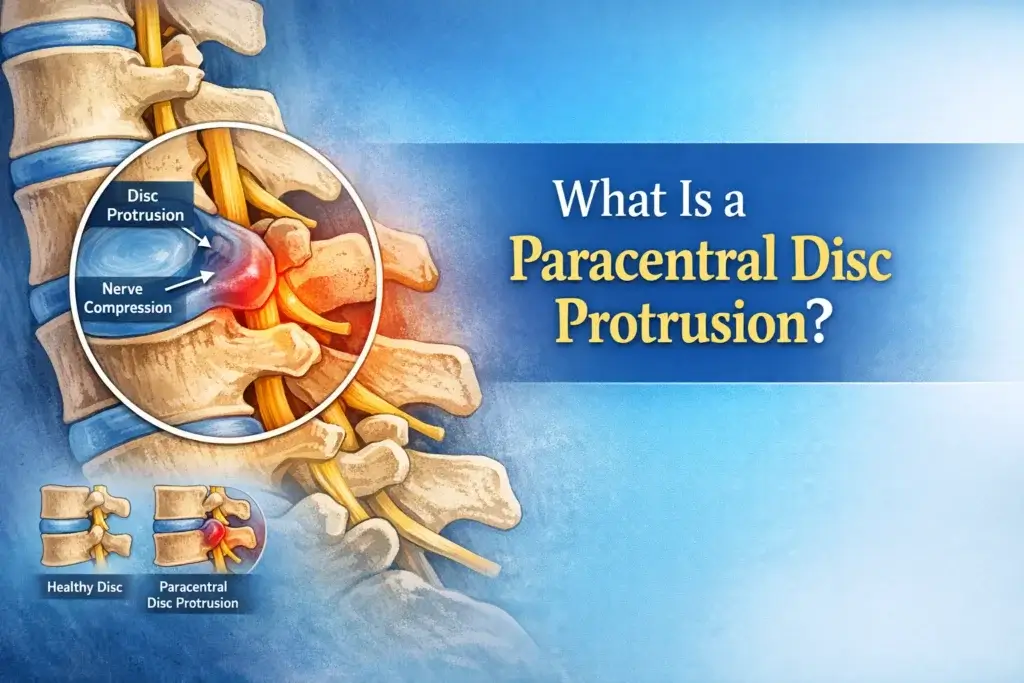
A paracentral disc protrusion is a common spinal condition that affects the discs located between the vertebrae of the spine. It occurs when the soft inner portion of a spinal disc pushes outward through a weakened area of the disc’s outer layer, slightly off to one side of the spinal canal. This position can place pressure on nearby nerve roots and lead to pain, numbness, or weakness depending on the location and severity.
Understanding this condition is important because paracentral disc protrusions are one of the most frequent causes of nerve-related back and neck pain seen in clinical practice.
Understanding Spinal Discs and Their Function

The spine is made up of bones called vertebrae. Between each vertebra sits a disc that acts as a cushion and allows movement. Each disc has two main parts:
- Annulus fibrosus – the firm outer layer
- Nucleus pulposus – the softer, gel-like center
When the outer layer weakens or develops small tears, the inner material can push outward. If this outward movement occurs slightly to the left or right of the center, it is called a paracentral disc protrusion.
What Does “Paracentral” Mean?
The term “paracentral” describes the location of the disc protrusion.
| Disc Location Term | Meaning |
| Central | Bulge directly in the middle of the spinal canal |
| Paracentral | Bulge just off-center, left or right |
| Foraminal | Bulge into the nerve exit opening |
| Far lateral | Bulge outside the spinal canal |
Paracentral protrusions are clinically significant because nerve roots travel close to this area, especially in the lower back and neck.
Common Areas Affected
Paracentral disc protrusions most often occur in:
- Lumbar spine (lower back) – L4-L5 and L5-S1 levels
- Cervical spine (neck) – C5-C6 and C6-C7 levels
These regions handle frequent movement and body weight, making them more prone to disc changes over time.
Symptoms of a Paracentral Disc Protrusion
Symptoms depend on which nerve is affected and how much pressure is present. Some people have no symptoms, while others experience persistent discomfort.
Common Symptoms Include:
- Localized neck or lower back pain
- Pain radiating into the arm or leg
- Numbness or tingling
- Muscle weakness
- Burning or sharp nerve pain
In lumbar cases, symptoms may follow the sciatic nerve pathway. In cervical cases, pain may travel into the shoulder, arm, or hand.
Causes and Risk Factors
Several factors contribute to the development of a paracentral disc protrusion:
- Age-related disc wear
- Repetitive bending or lifting
- Poor posture
- Sudden strain or injury
- Prolonged sitting
- Weak core muscles
Diagnosis
A thorough evaluation is required to confirm the diagnosis.
Diagnostic Methods:

- Physical and neurological examination
- MRI scan (gold standard)
- CT scan in select cases
An MRI provides clear detail of disc shape, nerve involvement, and surrounding structures.
Treatment Options
Most paracentral disc protrusions improve without surgery.
Non-Surgical Treatment
| Treatment | Purpose |
| Activity modification | Reduces stress on the spine |
| Physical therapy | Improves strength and flexibility |
| Anti-inflammatory medication | Reduces pain and swelling |
| Epidural steroid injections | Calms nerve irritation |
Surgical Treatment
Surgery is considered when pain persists or neurological symptoms worsen.
Common procedures include:
- Microdiscectomy
- Minimally invasive decompression
- Spinal fusion or disc replacement in advanced cases
Recovery and Outlook
The majority of patients experience meaningful improvement within 6 to 12 weeks with conservative care. Early diagnosis and appropriate treatment play a key role in preventing long-term nerve damage.