
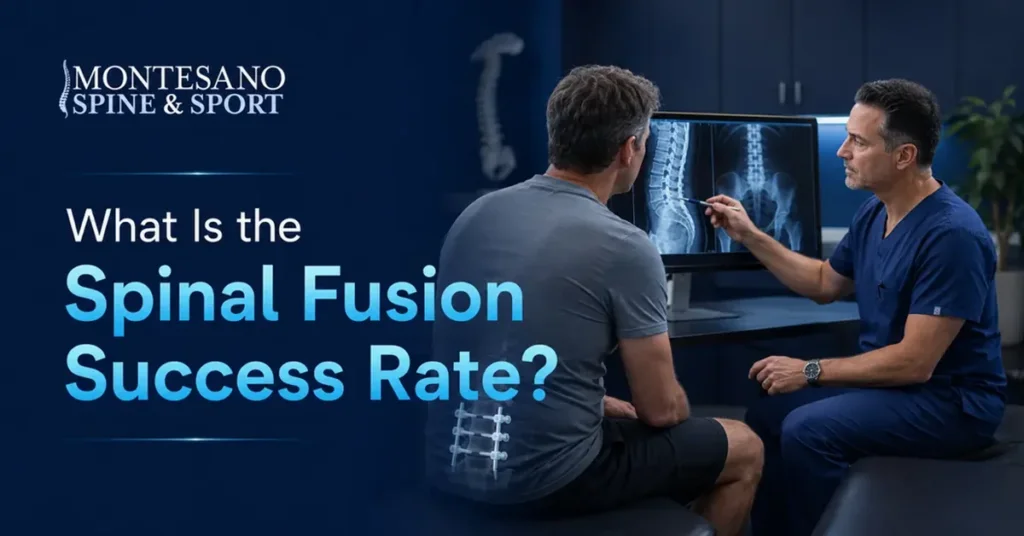
Quick Answer: There is no single spinal fusion success rate because “success” may mean solid bone healing, pain relief, neurologic improvement, return to work, or avoiding another operation. Outcomes vary by diagnosis, spinal region, number of levels, surgical approach, smoking, bone health, diabetes, and the way a study defines success.
A technically solid fusion can coexist with some pain, while a patient can feel better before imaging confirms mature bone healing. That is why a percentage without the operation, diagnosis, follow-up period, and outcome definition can mislead. A useful consultation separates radiographic fusion from the results that matter to the patient.
How Spinal Fusion Success Is Measured
| Outcome measure | What it answers | Important limitation |
|---|---|---|
| Radiographic fusion | Did bridging bone form across the intended level? | Definitions and imaging methods vary |
| Pain and disability | Did symptoms and daily function improve? | Improvement may be incomplete |
| Neurologic recovery | Did weakness, numbness, or walking improve? | Long-standing nerve damage may persist |
| Reoperation | Was another spine operation needed? | Depends on follow-up length and reason |
What Does Spinal Fusion Success Mean?
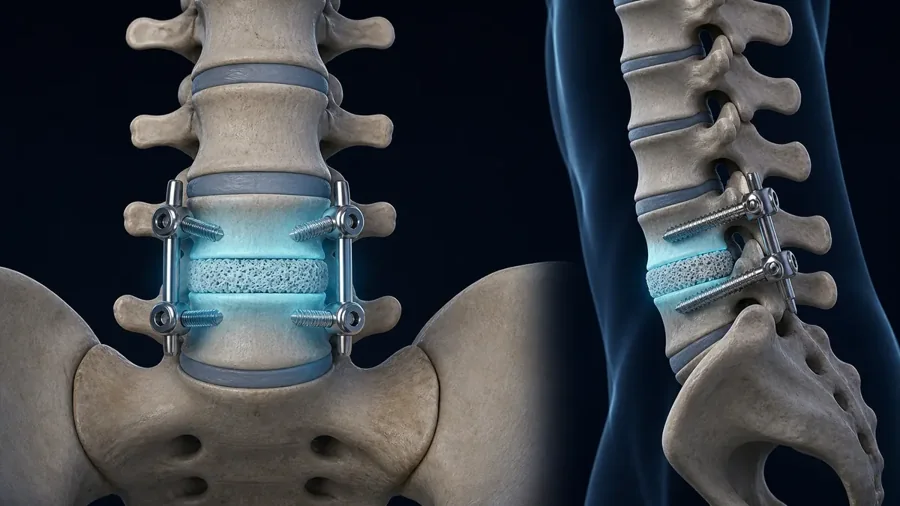
Spinal fusion joins two or more vertebrae using bone graft, often with screws, rods, plates, or cages to stabilize the segment while bone grows. It may be recommended for instability, deformity, fracture, certain cases of stenosis with instability, spondylolisthesis, or another defined structural problem.
Published rates cannot be combined into one reliable number because studies use different diagnoses, operations, imaging criteria, and follow-up periods. A 2025 systematic review of lumbar fusion assessment found no consensus definition for successful fusion. Ask for procedure-specific data and distinguish bone healing from patient-reported improvement.
Related SpineDocs reading: Lumbar fusion surgery and Laminectomy with fusion.
Key takeaway: A meaningful success estimate names the procedure, condition, time point, and exact outcome being measured.
Who Is Most Likely to Benefit?
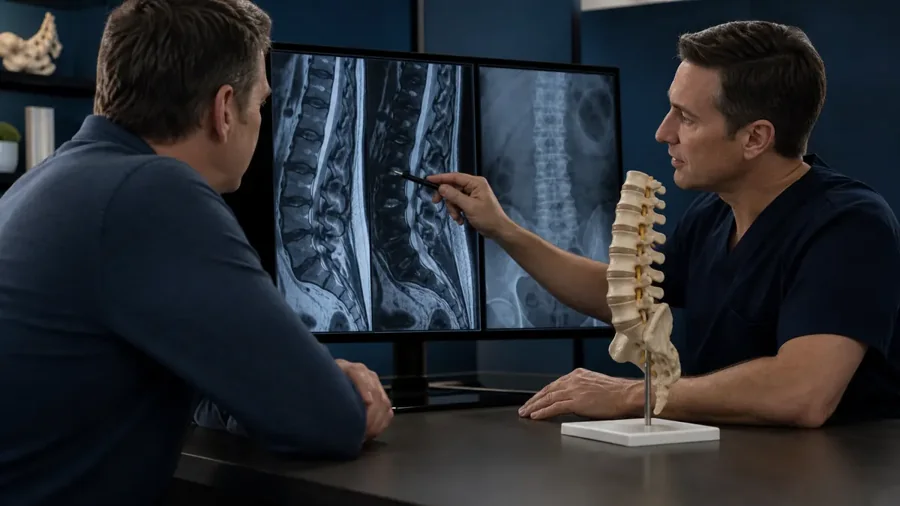
Results are generally more predictable when symptoms and imaging identify a clear mechanical problem that fusion can address. The evaluation should confirm that the painful or unstable level matches the clinical findings and that reasonable nonsurgical care has been tried when safe.
Risk assessment includes age, smoking or nicotine use, nutrition, diabetes control, bone density, body weight, medication use, mental health, number of levels, prior surgery, and work demands. Meta-analyses identify smoking, older age, and more fused levels as important pseudarthrosis risks; diabetes and vitamin D deficiency may also impair healing.
Key takeaway: The best odds come from treating a well-defined problem in a patient whose modifiable healing risks are addressed.
Recovery Timeline and Signs of Progress
Early recovery focuses on incision care, walking, pain control, and avoiding prohibited lifting, bending, or twisting. Activity expands in stages. Some patients return to light work within weeks, while heavier work and unrestricted exercise take longer. Bone healing is typically assessed over months, not by how the back feels during the first few weeks.
Progress may include improved leg symptoms, longer walking tolerance, reduced need for pain medicine, stronger movement, and stable imaging. The timeline differs by level and approach; see how long L5-S1 fusion surgery takes for one procedure-focused overview.
Best practices include following lifting restrictions, walking regularly, using prescribed rehabilitation, avoiding nicotine, supporting protein and vitamin D needs, controlling blood sugar, and attending follow-up imaging.

Key takeaway: Recovery is a staged process in which function may improve before the fusion is fully mature on imaging.
Long-Term Problems After Spinal Fusion
Possible long-term issues include persistent or recurrent pain, nonunion or pseudarthrosis, hardware loosening or breakage, scar-related symptoms, reduced segmental motion, and adjacent-segment degeneration. Radiographic wear next to a fusion is more common than symptomatic disease, and it does not automatically mean another operation is needed.
A meta-analysis estimated radiographic adjacent-segment degeneration after cervical fusion at about 5.9% per year and symptomatic disease at about 1.8% per year, but rates vary and imaging changes correlate only weakly with clinical outcome. Longer constructs can raise risk. Mental health, work loss, medication dependence, and financial strain may also affect quality of life and should be addressed directly.
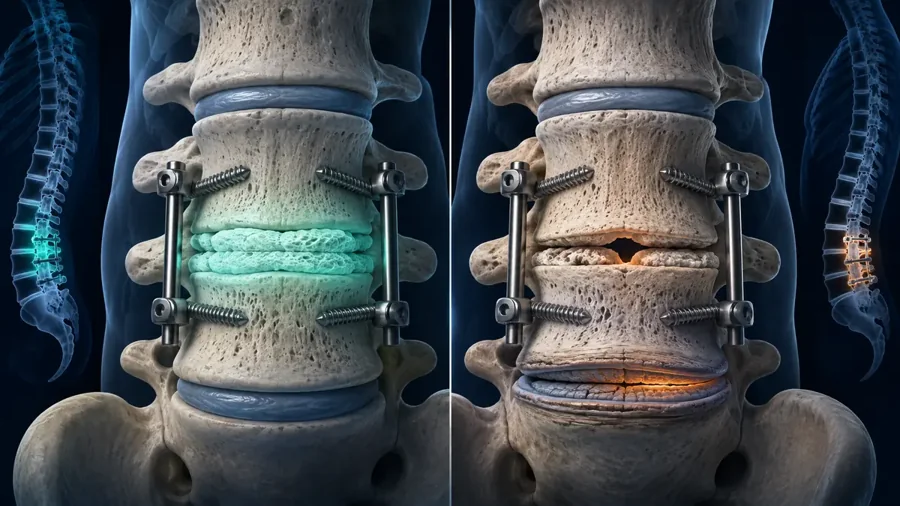
Key takeaway: Long-term imaging changes are not the same as symptoms; treatment depends on the cause of functional decline or pain.
Warning Signs of Failed Fusion or Another Problem
Persistent pain does not prove that a fusion failed. Concerning patterns include pain that never improves, pain that returns after initial recovery, new or progressive numbness or weakness, deformity, instability, or imaging that shows absent bridging bone or hardware changes. Infection, hip disease, sacroiliac pain, adjacent-level disease, and nerve injury can mimic nonunion.
Seek urgent help for new bowel or bladder dysfunction, saddle numbness, rapidly worsening weakness, fever with wound drainage, chest pain, or breathing difficulty. A second opinion may clarify whether rehabilitation, diagnostic injections, medication changes, hardware evaluation, or revision surgery is appropriate.
Key takeaway: A suspected failed fusion requires a fresh diagnosis rather than assuming every symptom comes from nonunion.
Fusion Alternatives and Common Decision Mistakes
Depending on the diagnosis, alternatives may include physical therapy, medication, image-guided injections, decompression without fusion, or motion-preserving surgery. Cervical artificial disc replacement is an option only for selected patients and is not interchangeable with every fusion indication.
Common mistakes include choosing surgery from an MRI alone, treating a universal percentage as a personal forecast, ignoring nicotine or bone health, expecting all pain to disappear, and comparing procedures designed for different conditions. Shared decision-making should define the symptom target, alternatives, likely tradeoffs, and plan if the expected improvement does not occur.
Key takeaway: The right comparison is diagnosis-specific, and the best operation may be no operation when the target is uncertain.
Conclusion
Spinal fusion success cannot be reduced to one percentage. The most useful estimate is tied to the exact condition, procedure, outcome, and time frame. Careful selection, risk-factor optimization, realistic expectations, and structured follow-up give patients the clearest path toward durable improvement.
Resources and References
Request an Appointment
Ready to discuss your symptoms or treatment options? Request an appointment with SpineDocs | Montesano Spine & Sport for an individualized evaluation.